
Best Rural Internet Providers in 2026, Compared
Starlink, T-Mobile, Viasat, HughesNet, fixed wireless, and Backroads WiFi, compared on price, speed, latency, and contracts. Here is how the options really stack up for rural homes.
June 2, 2026 · Backroads WiFi · 5 min read
Rural residents have more genuine internet options in 2026 than at any point in history, though the right answer varies a lot from one address to the next. Satellite, cellular home internet, and fixed wireless each win in different places. Below is an honest look at how the major providers stack up, and where Backroads WiFi fits in.
How the providers stack up at a glance
There is no single "best" for every rural property. It depends on what you value most. If your priority is flexibility, simple billing, and a real person to call, this is how we'd rank them:
- Backroads WiFi, best for flexibility and support. No contract, no credit check, fully mobile plans, low-latency cellular, and US-based help. Works wherever your phone gets a solid signal.
- Starlink, best raw performance and availability. Hard to beat on coverage and speed, but the highest upfront and monthly cost.
- T-Mobile Home Internet, best headline price. Unbeatable at $50 where 5G coverage is strong.
- Local fixed wireless (WISP), best when available. Low latency and strong value, but only if you have line of sight to a tower.
- Viasat, legacy satellite. Fine for browsing and streaming, rough for calls and gaming.
- HughesNet, budget satellite. Lowest tier of usage, locked into a 24-month contract.
Side-by-side comparison
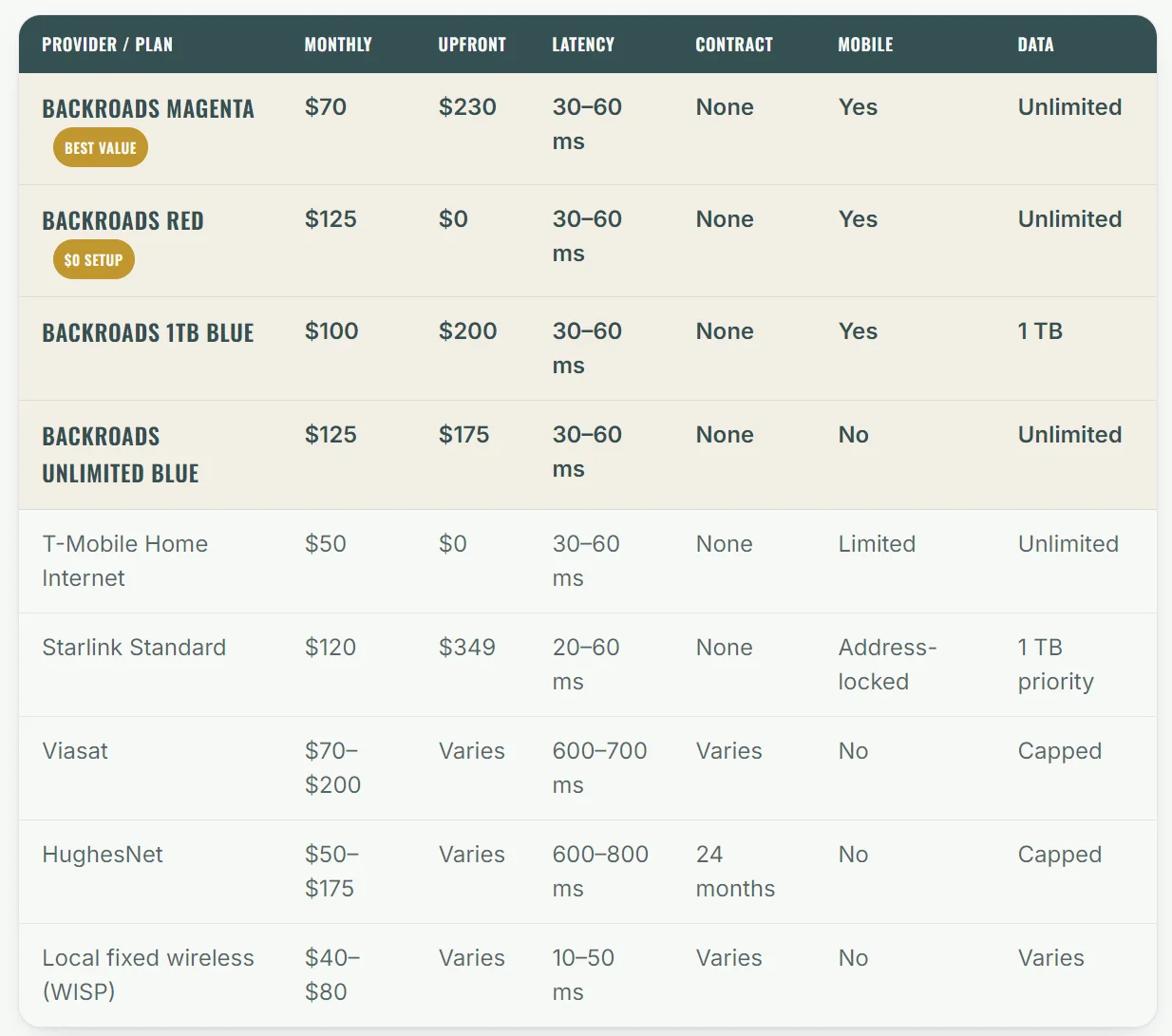
Our plans sit at the top. The dimensions that matter most to rural customers are contract terms, mobility, and latency, and that is exactly where cellular service like ours competes hard.
| Provider / Plan | Monthly | Upfront | Latency | Contract | Mobile | Data |
|---|---|---|---|---|---|---|
| Backroads MagentaBest value | $70 | $230 | 30–60 ms | None | Yes | Unlimited |
| Backroads Red$0 setup | $125 | $0 | 30–60 ms | None | Yes | Unlimited |
| Backroads 1TB Blue | $100 | $200 | 30–60 ms | None | Yes | 1 TB |
| Backroads Unlimited Blue | $125 | $175 | 30–60 ms | None | No | Unlimited |
| T-Mobile Home Internet | $50 | $0 | 30–60 ms | None | Limited | Unlimited |
| Starlink Standard | $120 | $349 | 20–60 ms | None | Address-locked | 1 TB priority |
| Viasat | $70–$200 | Varies | 600–700 ms | Varies | No | Capped |
| HughesNet | $50–$175 | Varies | 600–800 ms | 24 months | No | Capped |
| Local fixed wireless (WISP) | $40–$80 | Varies | 10–50 ms | Varies | No | Varies |
What you'll actually pay in year one
Headline prices hide the upfront cost. Here is the real first-year total, monthly plus equipment, for the plans that publish flat pricing.
| Plan | Monthly | Setup | First-year total |
|---|---|---|---|
| T-Mobile Home Internet | $50 | $0 | $600 |
| Backroads Magenta | $70 | $230 | $1,070 |
| Backroads 1TB Blue | $100 | $200 | $1,400 |
| Backroads Unlimited Red | $125 | $0 | $1,500 |
| Backroads Unlimited Blue | $125 | $175 | $1,675 |
| Starlink Standard | $120 | $349 | $1,789 |
Notice that Unlimited Red costs $0 upfront, which beats Starlink's $349 hardware bill and makes the first year cheaper overall, even at a similar monthly rate.
Latency: where cellular pulls ahead
This is the chart that matters most for video calls, gaming, and anything interactive. Cellular providers, including Backroads WiFi, sit down with the low-latency options. The geostationary satellites, Viasat and HughesNet, are in a different universe.
The competition, provider by provider
Starlink has earned its spot as the best overall for raw performance, with near-universal availability and latency in the 20 to 60 ms range. Standard runs $120 a month plus $349 for hardware, with speeds of 25 to 220 Mbps. The downsides are the higher cost and trouble on properties with heavy tree cover.
T-Mobile Home Internet is the value leader at $50 a month, no hardware cost, and no contract. Where 5G coverage is strong it rivals Starlink. The catch is that coverage maps are optimistic, so performance depends heavily on your distance from a tower and how many neighbors share it.
Viasat expanded capacity with its newest satellite and offers up to 150 Mbps in some regions for $70 to $200 a month. But 600 to 700 ms latency is baked in. Video calls feel laggy and gaming is essentially unplayable.
HughesNet is the budget satellite tier, capped around 25 Mbps with 600 to 800 ms latency and a required 24-month contract. Fine for email and basic browsing, not for remote work.
Local fixed wireless (WISPs) is the most underrated option when it exists. Speeds run 25 Mbps to 1 Gbps with 10 to 50 ms latency, but it requires line of sight to a tower, usually within 10 to 25 miles.
Where Backroads WiFi wins
We are not going to pretend we beat everyone on every spec. Starlink wins on raw availability and T-Mobile wins on sticker price. But for a huge share of rural households, the things that actually make the lifestyle work are exactly where we lead:
- Truly mobile. Magenta and Red work anywhere across America. Starlink's residential plan is address-locked.
- No contract, ever. Compare that to HughesNet's 24-month commitment.
- No credit check, no ID required. Service is prepaid and simple.
- $0 setup on Red. That removes Starlink's $349 hardware barrier entirely.
- Low-latency cellular. Right alongside Starlink and T-Mobile, and worlds ahead of satellite.
- A real person to call. US-based support that answers, instead of a chatbot and a ticket number.
The honest bottom line
The single most important step is to verify which networks actually reach your exact address, because coverage can change from one mile to the next. T-Mobile is the cheapest option where its signal is strong. Starlink wins on raw specs. But if you want mobility, simple month-to-month billing, no credit check, and a real person to talk to, Backroads WiFi is built for exactly that.
Check your coverage to see which network performs best where you are, then compare it against our plans. If your phone works there, our internet very likely will too.